> article
Design is a science. The process was never the point.
Every design-process framework ever taught — the double diamond, design thinking, the rest — looks like the scientific method and quietly skips its only rigorous step: the moment the work meets a real human and is allowed to fail. The discipline was always the test, not the diagram. For thirty years that test was too expensive to run, so designers performed the process and shipped on faith. AI just made the test cheap enough that there is no excuse left.
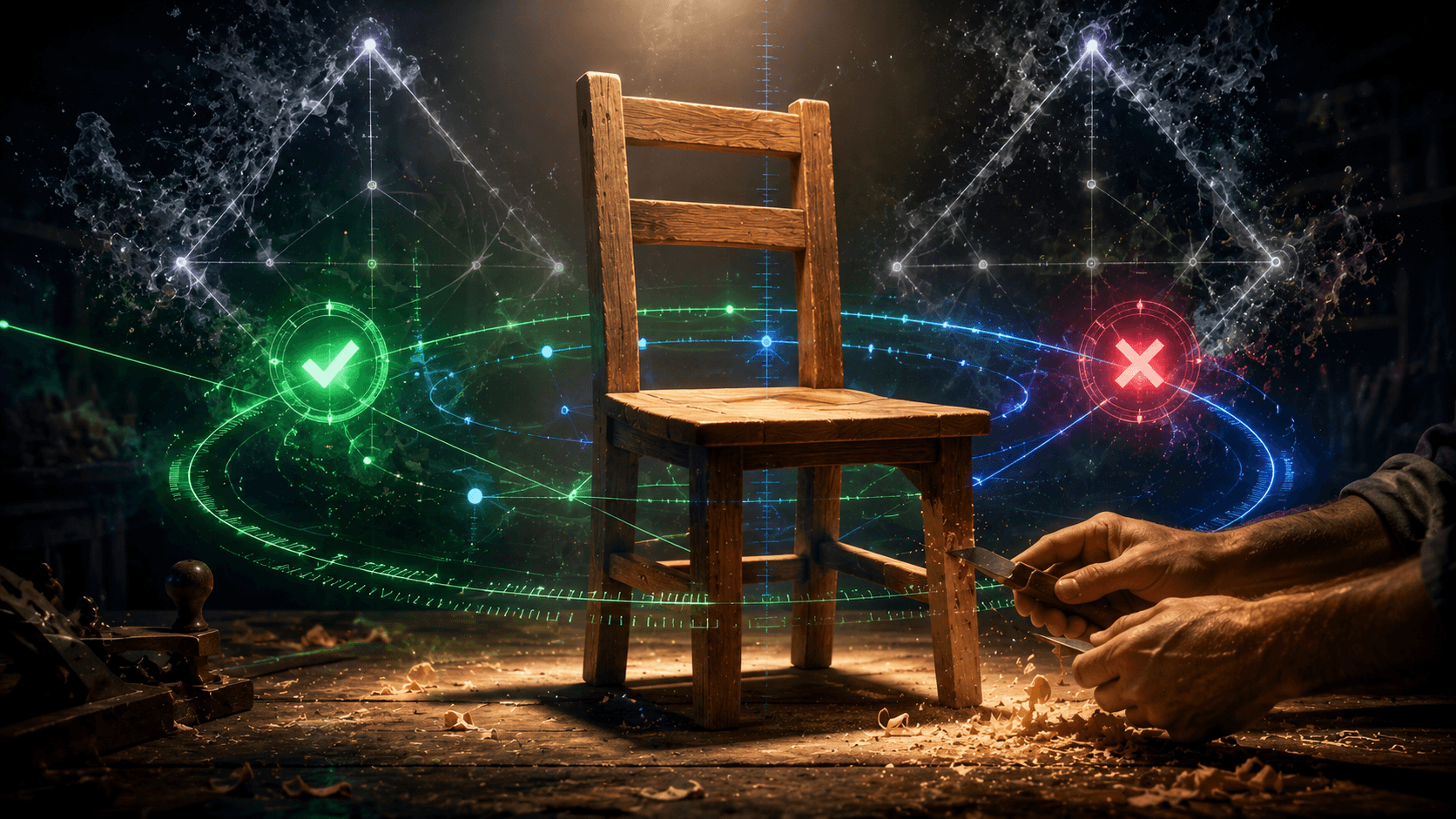
A carpenter has never drawn a persona. He builds the chair. He sits in it. He watches you sit in it. Then he shaves down the leg that wobbles.
That is the most rigorous thing in design, and he's been doing it for two thousand years without a single process diagram.
This is an essay about why he was right, and why most of what we call "design process" was never rigor at all. My claim is simple: design is a science. Not as a metaphor. In the literal sense — a way of finding out whether you're wrong before your users find out for you.
The loop that actually matters
Strip away the fashionable words and good design is four moves:
- Guess. "If I do this, the user will do that."
- Predict. Make it specific enough to be wrong. Not "users will like it." Instead: "eight out of ten people will finish signup without help."
- Test it cheaply. Build the smallest thing that could prove your guess wrong, and put it in front of a real person.
- Keep or kill. The prediction held, or it didn't. You iterate, or you throw it out.
That's the whole engine. Everything else — the research, the polish, the beautiful screens — either feeds this loop or it's decoration.
Notice move one. You start with a guess. A solution, stated early. This bothers people, so let me be clear about why it's correct.
A guess is a hypothesis. "This dashboard should lead with the chart, not the table" is a hypothesis. A scientist doesn't spend six months gathering context before forming one. They make a bold, specific claim early — because you can't run a test on a question. You can only run a test on an answer. The claim is what makes the test possible.
What we got sold instead
Now look at what design process actually produced for thirty years. Personas. Empathy maps. Journey maps. Walls of sticky notes, photographed for the case study. Figma files with forty screens and a clickable prototype no real user ever touched.
Every one of those is a claim that never got tested.
A persona is a story the team agreed on. A journey map is a diagram of what you assume people do. A wireframe is a guess in grey boxes. None of them are evidence. You present them, the room nods, and the guess quietly becomes "fact" because everyone agreed. Then you build on top of it.
Here's why this kept happening. A persona deck is easy to grade. A real user experience is not. So the industry taught the thing it could grade, called it the discipline, and a whole generation learned to polish the deck instead of testing the design.
It also felt rigorous, because it was a lot of work. But effort is not evidence. You can spend three weeks on a persona deck and learn nothing about whether your design works — because you never built the step that could tell you.
Take the double diamond, the most famous process diagram of all: discover, define, develop, deliver. It has neat stages and arrows. It gets taught as if it were the scientific method for design. But ask it one question — where is the step that proves you wrong? — and it has no answer. "Develop" means make the screens prettier. "Deliver" means ship. Nowhere does the design meet a real person in a way where it could fail and you'd have to admit it. A stakeholder sign-off stands in for the test. But a stakeholder isn't a user. A stakeholder is someone with opinions and a budget.
I'm not here to attack one diagram, though. The double diamond is just one example. The real problem is bigger: we started believing that rigor lives in the procedure, when rigor actually lives in the test. Swap the double diamond for any other framework and the same hole is there if there's no step that can prove you wrong.
Every decision is a claim
This gets obvious fast in interface work, because every UI decision is already a claim about a person — and most designers never treat it that way.
"This icon reads as archive." That's a claim. It's true or false. You can check it this afternoon: show the icon to ten people, ask what it does, count the right answers.
I once watched a "completely obvious" icon score 31%. The designer who drew it said the test was unfair. The test wasn't unfair. The icon was wrong. He'd spent a week perfecting a symbol two out of three people couldn't read.
"Users will notice the secondary button." Claim. "The empty state explains itself." Claim. "Nobody will miss the filter if I hide it in a menu." Claim. Every one is a bet about what a real person will see and do. Every one is checkable in hours.
The bigger UX questions work the same way. "People abandon the form because it's too long" is a hypothesis. The drop-off funnel is the experiment. You don't need a journey map to find where people quit — you need the drop-off number and one screen recording of someone actually quitting. The map is your guess about the journey. The recording is the journey.
This is the field Don Norman built. Affordances, mappings, the way a control connects to its effect — these are testable predictions about how the mind works, not matters of taste. Somewhere along the way, "does this match how people think?" got replaced with "does this look like the work that got hired last year?" The first question is science. The second is fashion.
What AI actually changed
Here's the part everyone gets backwards.
AI didn't make design rigorous by making it faster. It removed the one expensive step that let us skip the test.
For thirty years, the gap between "I have a guess" and "a real person is using the real thing" was huge. A week drawing in Figma. A week handing it to engineers. Then review cycles. Running one honest test cost about a month. So most teams never ran it. They held a review meeting instead and shipped on faith. Given the cost, that was almost reasonable.
Now a sketch becomes working software in an afternoon. A description becomes a deployed app. The cost of testing your guess has collapsed. The experiment that the old process quietly avoided is suddenly the easiest step you have.
That's the real shift. Not "design got faster." The step where you find out you're wrong got cheap — so there's no excuse left to skip it. The old process existed to manage the cost of making artifacts. The artifacts aren't expensive anymore. Remove the ritual built around a cost that's gone, and what's left is the part that should have been there all along: the test.
The carpenter never needed the ritual. He sat in the chair. The running product is the chair. Everything before a real person uses the real thing is just a guess waiting to be tested.
How I work now
I stopped designing in Figma for anything that would ship in 2024. Not because Figma is bad — it's a wonderful drawing tool. But the drawing was the expensive step keeping me from the test.
Here's the loop now. I hold a guess about what the user needs. I build the smallest real version directly in code, with a live link. A real user is on it within the same week. I watch what they actually do — not what they say. The prediction held, or it didn't. I keep it, or I kill it.
Three rounds of Figma feedback take three weeks. Three rounds of build-it, ship-it, watch-someone-use-it take three days. The Figma version wasn't more careful. It was slower and blinder — slower because of the handoff, blinder because everyone was reviewing a picture of a product. You can't run an experiment on a picture.
"Beginners have no instincts"
The fairest objection: process is the manual a new designer doesn't have yet. You can't tell a junior to "trust your gut" — they don't have a gut yet. Without some structure, they'll just flail faster.
That's true. So here are two answers.
First: the four-move loop is the manual, and it's a better one. "Guess, predict, test, keep or kill" is teachable on day one. And it's easier to learn than the double diamond, because every step gives you an answer. You find out whether you were right. The old process taught beginners to make artifacts and never told them if the artifacts were any good. The loop has feedback built in.
And that feedback is how instincts get built in the first place. You don't develop taste by drawing journey maps. You develop it by being wrong in front of users, and remembering. Every time you're wrong cheaply, you've earned a little instinct you didn't have before. That growing pile of instincts is the thing people call taste — and it's the one thing AI still can't hand you for free.
Second: the test doesn't replace understanding. It's how you earn understanding instead of just claiming it. A guess you never test isn't understanding. It's a belief you've grown attached to.
Where to start
Pick your next real design decision — one screen, one component, one flow.
Before you draw anything, write down the guess in one sentence, and the prediction as a number you could be wrong about: eight out of ten people will find the settings without me pointing.
Then build the cheapest thing that could break that prediction, and put it in front of three real people this week. Not stakeholders. People who'd actually use it.
You'll be wrong more often than you expect. That sting is the whole point. It's the information the old process spent thirty years protecting you from.
So stop grading yourself on the artifact. A beautiful file that was never tested is just a beautiful untested guess. Start grading yourself on how fast you can find out you're wrong.
A design decision was always a bet on a person. You either checked the bet against a real one, or you prayed and shipped and called the praying "process." For thirty years, checking was expensive, so praying made sense. That's over now. A button is a claim about a mind. A flow is a guess about behavior. You can test both before lunch.
The designers who last won't be the ones with the prettiest diagrams. They'll be the ones who find out they're wrong before anyone else does.
The carpenter knew it all along. He never trusted the drawing. He sat in the chair.