> article
UX was never about screens.
Don Norman coined 'user experience' to mean five things — the object, the graphics, the screen, the physical interaction, and the manual — and the industry spent the years that followed deleting four of them until UX just meant Figma. Bootcamps sold a whole generation that narrow version, charging lakhs to teach the one part of design AI can now do in seconds. The carpenter shaping a chair was always doing the real work; he just never needed the title. The screen specialists who never learned the other four are the ones now competing hundreds-deep for jobs that are vanishing.
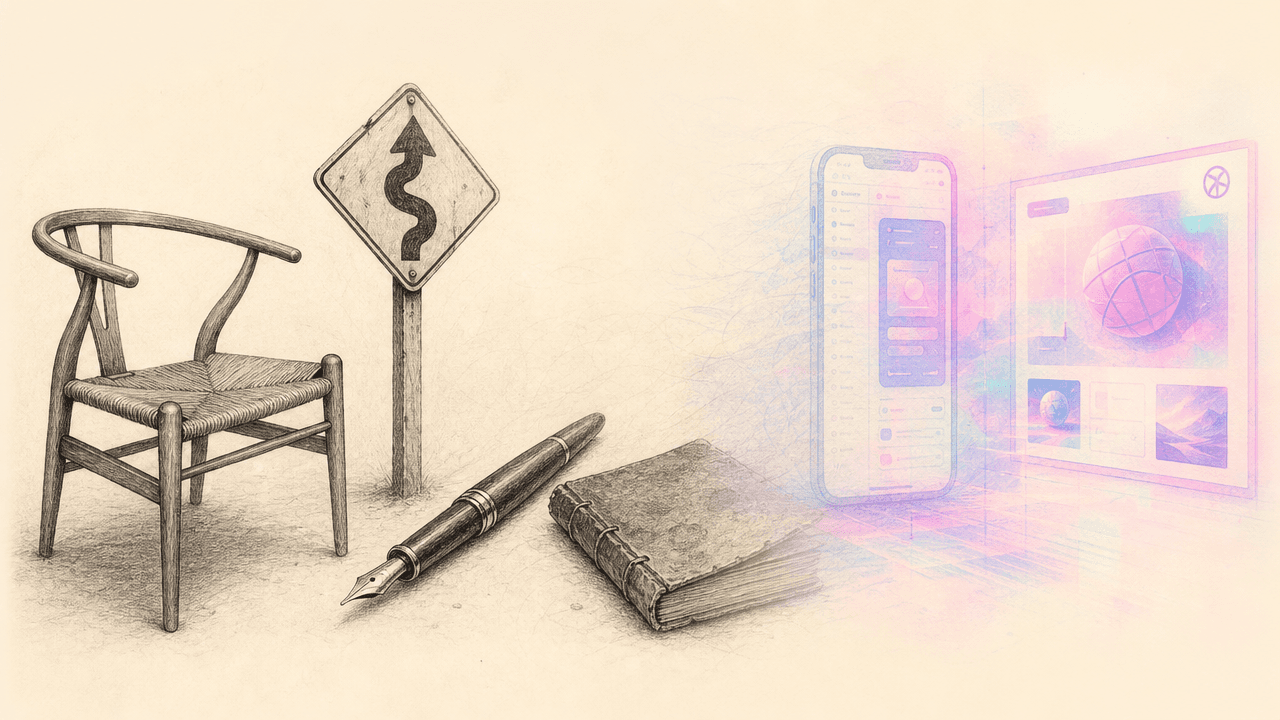
When Don Norman coined "user experience," he meant five things: the object's design, the graphics, the screen, the way your body interacts with it, and the manual. Over the next thirty years, the industry quietly deleted four of those and kept only one — the screen. UX came to mean Figma. Then bootcamps sold a whole generation that narrow version, charging lakhs to teach the one part of design that AI can now do in seconds. The result now: hundreds of people competing for each junior job, for a role that's quietly disappearing.
A carpenter shaping a chair was always doing the real work. He just never needed the title. This essay is about how design got shrunk to screens, who made money from it, why AI is ending it, and what the designers who survive will actually look like. It's for designers deciding what to learn next, and for the founders and leaders deciding who to hire.
Where the term came from
Don Norman joined Apple. The title he and Apple invented for him was "User Experience Architect" — the first time those words appeared in a job title. He chose it on purpose, because the words people used then — "human interface," "usability" — sounded like they were only about screens.
Two years later, he explained what he actually meant. He wanted the term to cover all of a person's experience with a system: the design of the object itself, the graphics, the interface, the physical interaction, and the manual.
Five things. The screen is just one of them.
For thirty years, the industry took that five-part idea and erased four parts. UX became the interface. The interface became the screen. The screen became Figma. A term Don Norman created to widen design ended up meaning "make screens."
The chair has UX
A carpenter making a wooden chair has always thought about the user. The seat height. The curve for your lower back. Where your arms rest. Whether your knees clear when you sit. Whether a child can climb into it.
He doesn't call himself a UX designer. He calls himself a carpenter. But he's doing user-experience work — thinking from the user's body back into the object — and he's been doing it for two thousand years.
So has:
- The road engineer thinking about what a driver can see at a junction, and where to place the sign.
- The pen maker thinking about grip, ink flow, and the angle the tip meets the paper.
- The teacher sequencing a lesson so understanding builds instead of collapsing.
- The waiter watching a table for the exact moment a guest wants water, or the bill.
None of them have a Figma file. None of them write a "case study." None of them call it UX. And every one of them is doing the work Don Norman's term was meant to cover.
UX was never a profession. It was a practice — something any maker does when their work touches a person. Norman's contribution was just to give the practice a name, so it could be taught. And that name is where the trouble started.
Why the screen won
In the years that followed, three things happened together that shrank "user experience" from five things to one.
First, screens became the thing people touched all day. Before long, we were spending more attention on glowing rectangles than on chairs, doors, or signs. The discipline that thought about the rectangle naturally got more attention than the ones that thought about everything else.
Second, tech made screens cool. Apple, Google, and the rest made digital design glamorous in a way wooden chairs never were. The tools were exciting, the salaries were high, the jobs were in cities. Design students got the message: if you want a career, screens are where the money is.
Third — and this is the real damage — the term got stuck onto job titles. Norman meant a practice: the act of thinking about the user. The industry turned it into a role: the person whose job is to think about the user. Once UX was a role, it had to be a specific thing you got hired for. That thing was screens — because screens were where the hiring was.
The carpenter never needed the label, because his skill was carpentry and the user-thinking came built in. The screen designer needed the label to stand apart from the engineer, the graphic designer, the project manager. So the term became a gate you had to pass through to get a digital job. And once there's a gate, someone starts charging admission.
The bootcamp economy
Over the next decade and a half, a whole industry grew up to teach UX. General Assembly, Springboard, CareerFoundry, and dozens more. Nearly every university launched a "UX program" — one-year masters, eighteen-month diplomas, twelve-week certificates.
The curriculum was almost entirely about screens. Design-thinking workshops. Persona templates. Journey maps. Wireframing in Figma. Usability tests of digital prototypes. How to build a portfolio that looks good on Dribbble.
What they did not teach: how a chair gets designed. How a road gets engineered. How a service handles a customer across thirty touchpoints over a year. How a museum moves a visitor's body through a space. How a manual gets written so a person can actually find the answer they need.
A whole generation paid lakhs for these programs and graduated believing UX is what you do in Figma. Their portfolios were full of "redesigns" of Spotify, Netflix, and Uber. They were sold a job description dressed up as a philosophy.
The bootcamps made money. The students paid. The job market hired just enough of them to keep the belief alive. That balance held for about fifteen years.
The part AI can do
Look again at Norman's five parts. Each is its own deep field:
- Industrial design — kettles, chairs, the phone as a physical object. Think Dieter Rams, Jony Ive.
- Graphics — layout, packaging, wayfinding. Think Massimo Vignelli, Paula Scher.
- The interface — the digital screen layer. This is the Figma crowd.
- Physical interaction — how your body meets an object: how a doorknob turns, how a gear shift resists, the weight of a good pen.
- The manual — the help text, the onboarding, the tutorial. The thing that decides whether you can recover when something goes wrong.
A bootcamp that teaches the third item and skips the other four isn't teaching UX. It's teaching screen tools and calling it UX because the word sells.
And the students who only learned the screen are now in trouble — because the screen is exactly the part AI can do.
The bubble pops
Here are the numbers.
UX job listings now get 500 to 800 applicants each. One senior designer reported reviewing 300 applications for a single role. The clearest summary of the field concluded the same thing: the supply of aspiring UX people keeps outpacing the open jobs, especially at the junior end.
There's a name for the trap: the Junior Paradox. A senior designer with AI tools now produces what used to take two juniors. So companies stopped hiring the juniors. The entry-level job — the one where designers used to learn the craft — is being wiped out.
The reason is simple. AI tools generate wireframes, mockups, and whole flows in minutes. The task that took a junior four hours — make a clickable prototype of a sign-up flow — now takes a tool fifteen seconds. There's no longer a training rung between "bootcamp graduate" and "senior," because the training rung's output is now free.
Falling demand on top of unchanged supply is what 500 applicants per listing looks like. Wages don't crash immediately — they cling to the senior layer where AI can't substitute — but the number of jobs at the bottom collapses. And the graduates who paid lakhs find the job they were sold no longer exists.
This won't be a soft landing. The bootcamps will deny it as long as people keep paying tuition. LinkedIn will fill up with "how to upskill for the AI era" posts. Juniors will keep applying to listings that already have 600 applicants. The math doesn't care about any of it.
What survives
The five-part version of UX survives. Specifically:
- Industrial designers. AI still doesn't make a kettle or fit a phone to your hand.
- Graphic and brand designers who can hold a whole visual system together. AI spits out options; it doesn't decide which one is right for the brand.
- Service designers who think across thirty touchpoints, a dozen teams, a year of contact. That's mostly strategy; the screen is one small piece of it.
- Physical-interaction designers — haptics, ergonomics, the feel of a brake pedal. Niche, but durable.
- Information architects and strong content/technical writers — the people who can structure a help system or write onboarding that actually onboards.
- Product designers who can ship — who think across several of Norman's five parts, can write or read code, hold a user's mindset and a business metric in the same sentence, and don't need a Figma file to make their point. AI amplifies these people; it doesn't replace them.
What does not survive: the screen specialist who works only in Figma, builds Dribbble portfolios, redesigns existing apps as fake case studies, and got hired straight out of a bootcamp into a junior role. That role was the bubble. The bubble is popping. There's no kind way to write that sentence.
The honest counterargument
The strongest counter: maybe the graduates adapt. Maybe AI amplifies their work too, like it does for seniors. Maybe the field reshapes instead of collapsing.
Two problems with that.
One: adapting needs a foundation they were never given. A graduate who only learned Figma can't pick up industrial design from a YouTube video. The other four parts are deep fields — materials, ergonomics, visual perception, information theory — built over decades. Bootcamps skipped all of it. Students were sold the easy version, and the easy version is exactly what's being eliminated.
Two: adapting takes time, and the job market won't wait. A graduate job-hunting today is up against 500 other applicants, AI-boosted seniors, and employers who've already noticed AI can do the work. The window to retrain is closing while they're still mid-application.
Some will make it — the ones who realized, in time, that screens were always one item on a five-item list, and started learning the rest. Most won't.
Where to go from here
If you're a junior designer right now: stop polishing your Figma craft. Build one real thing — a website, an app, a small tool — and put it online. The portfolio that gets hired now is a list of working links. Then pick one of Norman's non-screen parts — service design, content design, brand systems, hardware-adjacent work — and learn it deeper than your peers.
If you're thinking about a bootcamp: don't. Read Norman's The Design of Everyday Things. Read Vignelli's The Vignelli Canon. Build something. Ship it. The bootcamp's job — turning you into "a junior with a portfolio" — was built for an older job market, and that market is gone.
If you're hiring: stop reading "UX bootcamp graduate" as a plus. Look for evidence that someone shipped a real thing, in any medium. The bootcamp signal is noise now — sometimes worse than noise.
If you're a senior designer worried about your career: you're mostly fine. Stay in the layer where judgment compounds — strategy, systems, decisions. Don't drift back down into just making screens.
The close
The carpenter making a chair was always doing UX. He never needed a job title. The chair was the proof.
The next ten years of design careers will look more like the carpenter than the bootcamp graduate: specific work, on specific things, with real evidence of having shipped — proven by what you made, not by a certificate.
If you ever find yourself wondering why the UX job market never recovered, read Norman's five-part list one more time. The answer was there the whole time.