The OS of pharma manufacturing. Six years, 51 customers, 370 plants.
I joined as Day-1 designer in 2020 and built it from Digital Work Instructions for 4 pharma customers to a Manufacturing Execution System for 51 regulated enterprises across 4 continents.
ROLE
Head of Design
TIMELINE
2020 – Present (6+ years)
TEAM
5
SCOPE
Enterprise SaaS
I joined Leucine in 2020 with a single design seat. The product was DWI — Digital Work Instructions, paper-on-glass for shopfloor operators on industrial tablets. The wedge was 21 CFR Part 11 compliance plus a stripped-down prototyping module that let pharma teams compose their own SOPs. One thing worked against me — zero pharma background — and one for me: the founder said yes to a strategy I argued for in week three.
Six years later, the same primitives I drew in 2020 run an entire MES platform: DWI → ePBR → eBMR → full Manufacturing Execution System → LeucineOS. One platform, three hubs (Manufacturing / Quality / Lab), one ontology underneath. I designed it from solo hire through Head of Design.
Scope, in brief:I designed the interface and interaction layer across the platform. The ontology-first direction was the CPO's strategic call, and Cortex was built by a separate engineering team — full boundary in §06.
From one object to two: checklist as template, job as instance.
In the first version, a checklist wasa job. Within four months every customer plant had local SOP variants — Cipla Indore's tablet-coating cleaning was a different checklist from Cipla Goa's, even though the master procedure was identical. QA reviewers were drowning: the same SOP existed as 40 forks across 12 sites. The product was getting harder to use the more it was used.
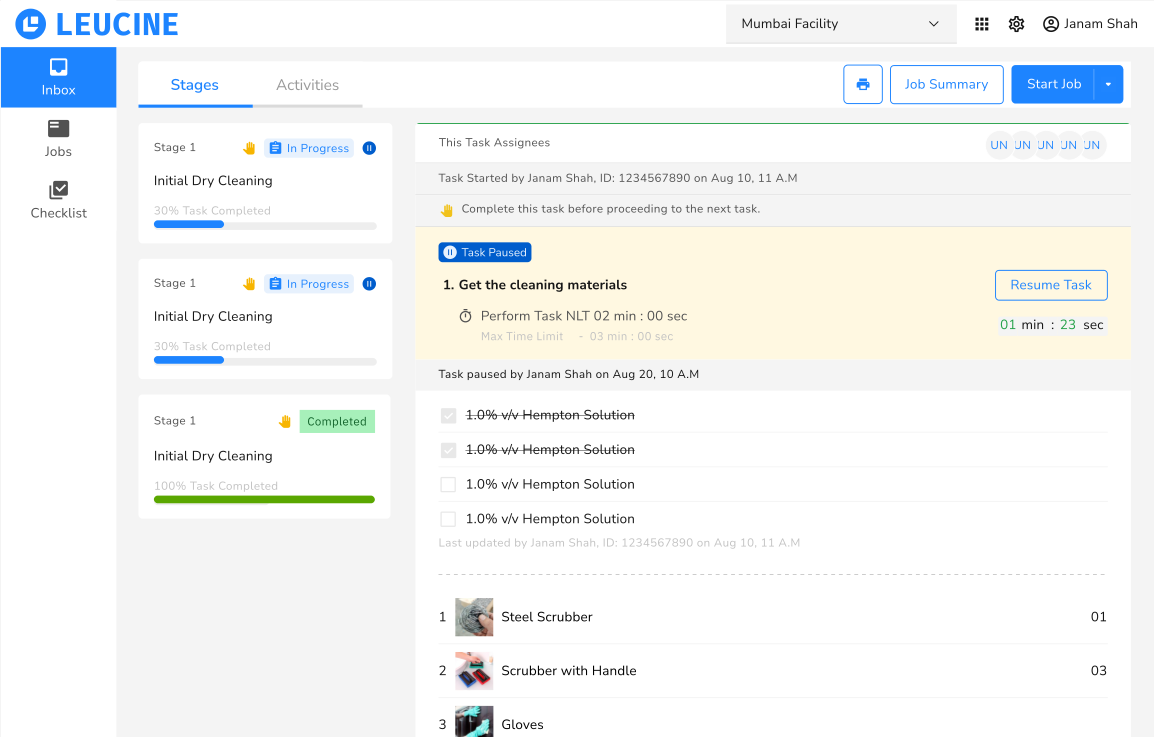
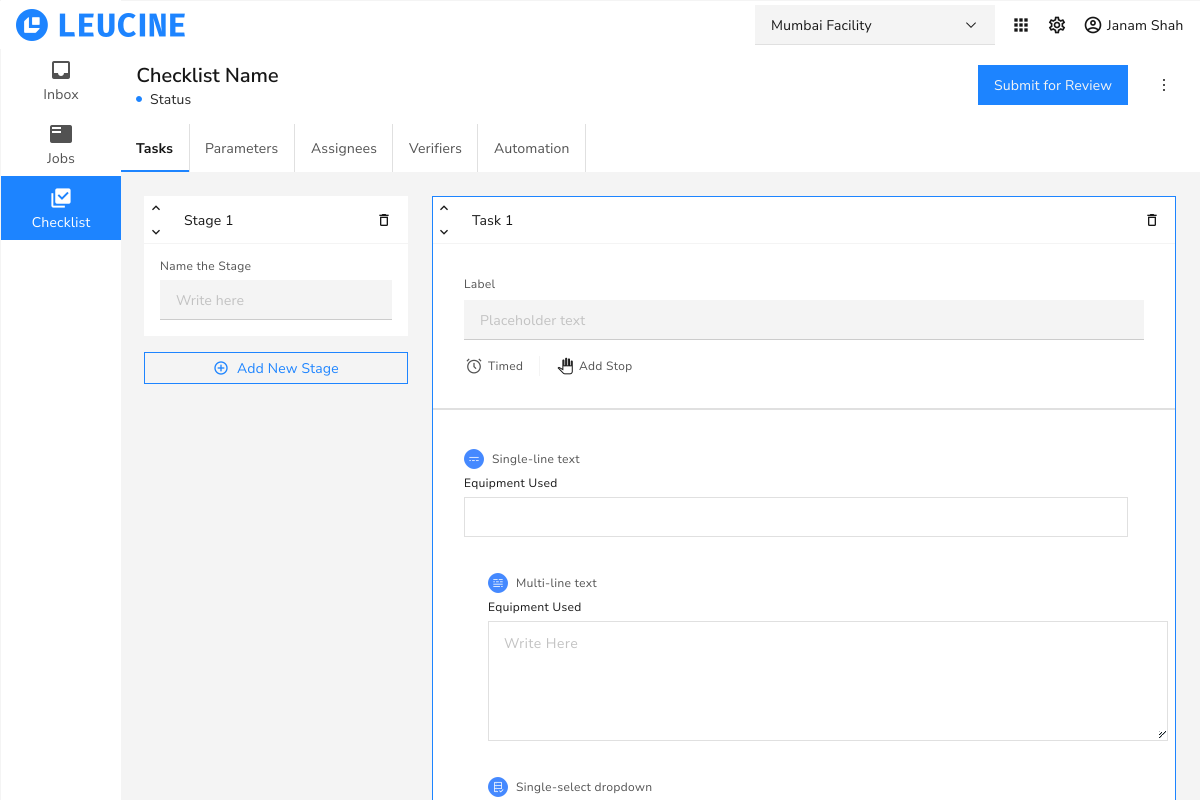
The fix was to separate master (the template) from instance(the executed job). I rebuilt the data model and the UI in the same month. I didn't know it then, but ISA-88 had codified this exact separation in 1995.
DWI → ePBR → eBMR → MES → LeucineOS. Every step extended the platform without replacing it. The same task object, signature object, and audit trail that ran a cleaning checklist in 2020 today runs a 14-stage tablet-manufacturing batch at Cipla. Compounding, not rebuilding.
2020 · DWI
Digital Work Instructions — paper-on-glass for shopfloor operators on industrial tablets, 21 CFR Part 11 compliant. Four customers, $6,000 per facility. The primitives — task, signature, audit trail, mandatory block — were set here.
2022 · ePBR
Electronic Production Batch Record — the first module bridge. Cleaning checklists rolled up into the batch; I extended master/instance from a single SOP to a hierarchy — procedure → unit operation → phase.
2023 · eBMR
Electronic Batch Manufacturing Record — full batch-record digitization. Stage chaining, weighing-balance integration, equipment logs, regulator-signable PDF, structured tolerance, IPC primitives, dual signature.
2024 · MES
The product crossed from digital paperwork to execution layer — equipment integration, IoT andon lights, real-time job orchestration, multi-site coordination. The wedge had eaten the category.
2025– · LeucineOS
Three hubs unified: Manufacturing (MES), Quality (CLEEN, deviations, change control), Lab (LIMS-adjacent). One ontology underneath, one Intelligence Hub on top.
The product got harder to use the more it was used. That meant the abstraction was wrong — not the screens.
The intuitive 2020 fix would have been a surface fix: the checklists are multiplying and getting messy, so add search, add folders, add filtering. That treats the symptom. The real gap was structural — a checklist was modelled as a job, so every execution forked a new template, and 40 versions of one identical SOP piled up across 12 sites. No amount of UI polish fixes a model where using the product creates the mess.
Separating the template from the executed instance is the one decision the entire six-year platform compounded on. It's also the transferable diagnostic I still lead with: if a system feels harder to use the more it's used, the abstraction is wrong, not the surface. Every later step — procedure hierarchies, batch records, the execution layer — was the same primitive extended, not a rebuild, because the model was right the second time.
What six years of compounding produced. The same primitives, recomposed across nine modules.
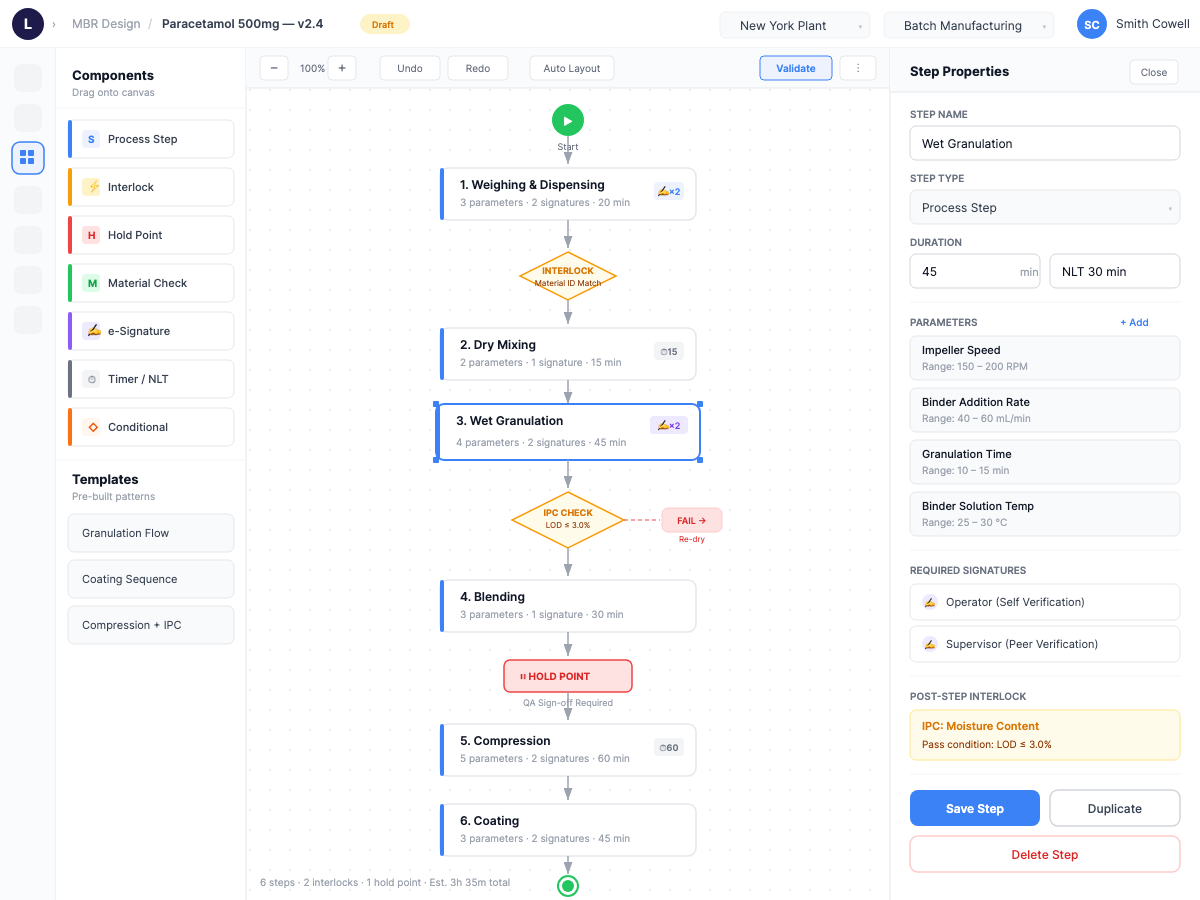
The master record, being designed.
A visual builder for the master batch record: process steps, interlocks, hold points, material checks, e-signatures, timers, conditionals — dragged onto a canvas, with step properties, required signatures, and post-step IPC interlocks configured per node.
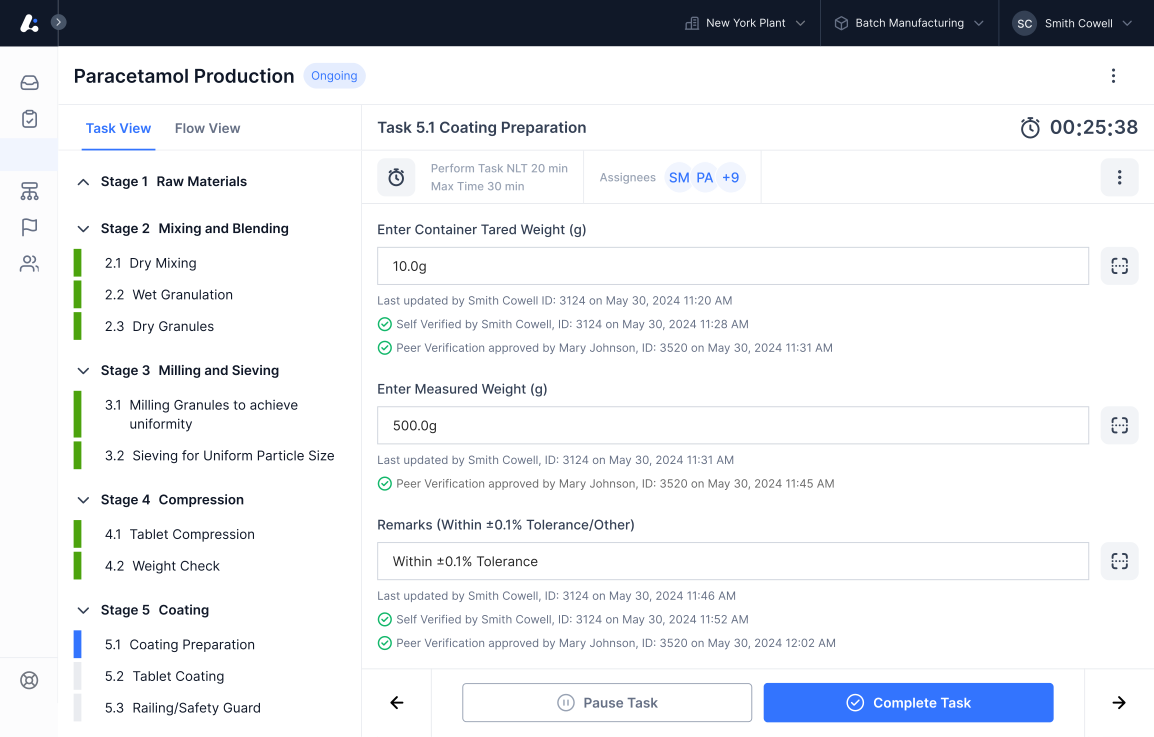
The operator execution surface, 2020 → 2026.
The surface a gowned operator touches on an industrial tablet, evolved across six years — staged task view, inline self- and peer-verification stamps, tolerance handling, complete-task gating.


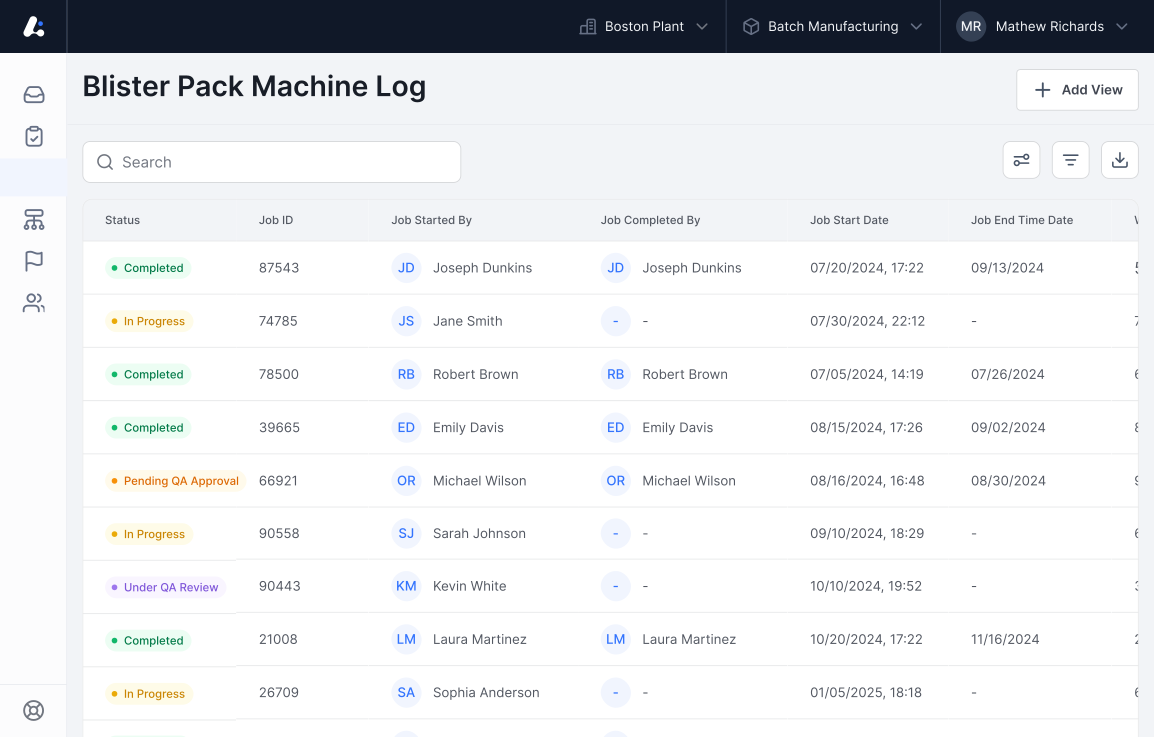
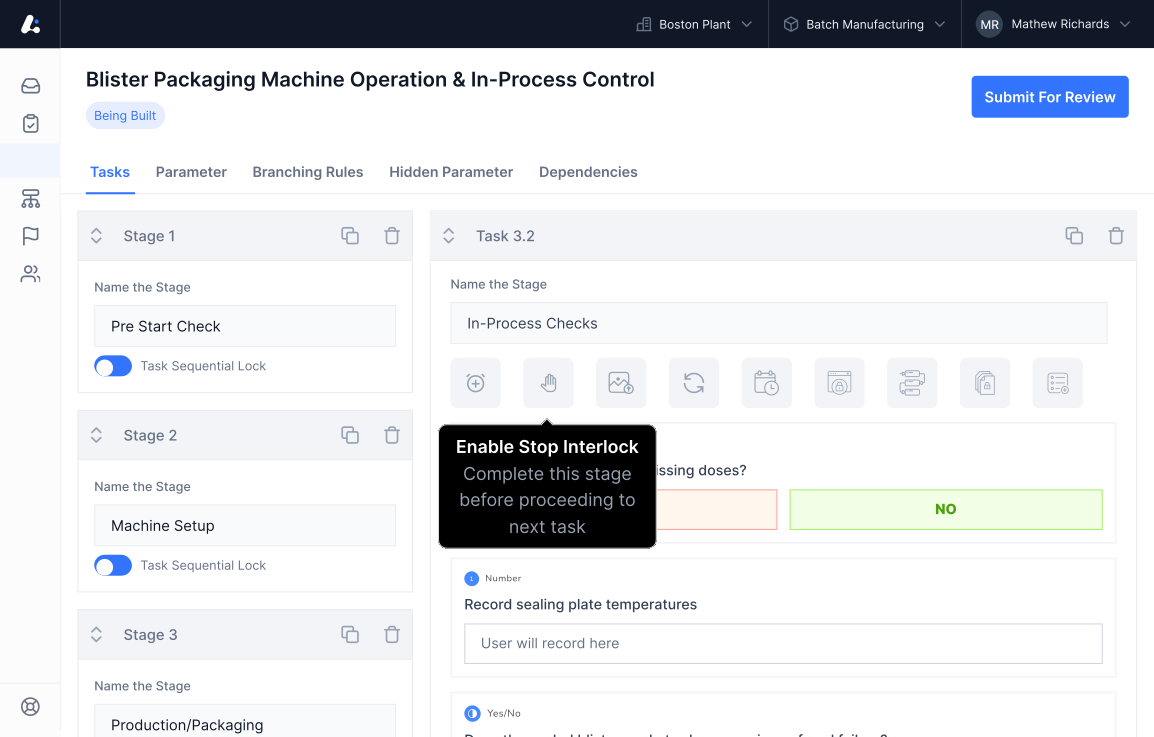
The integrated logbook — live view and builder mode.
Operations logged in live view; the same structure composed in builder mode, with enable-stop interlocks (“complete the stage before proceeding to the next task”).
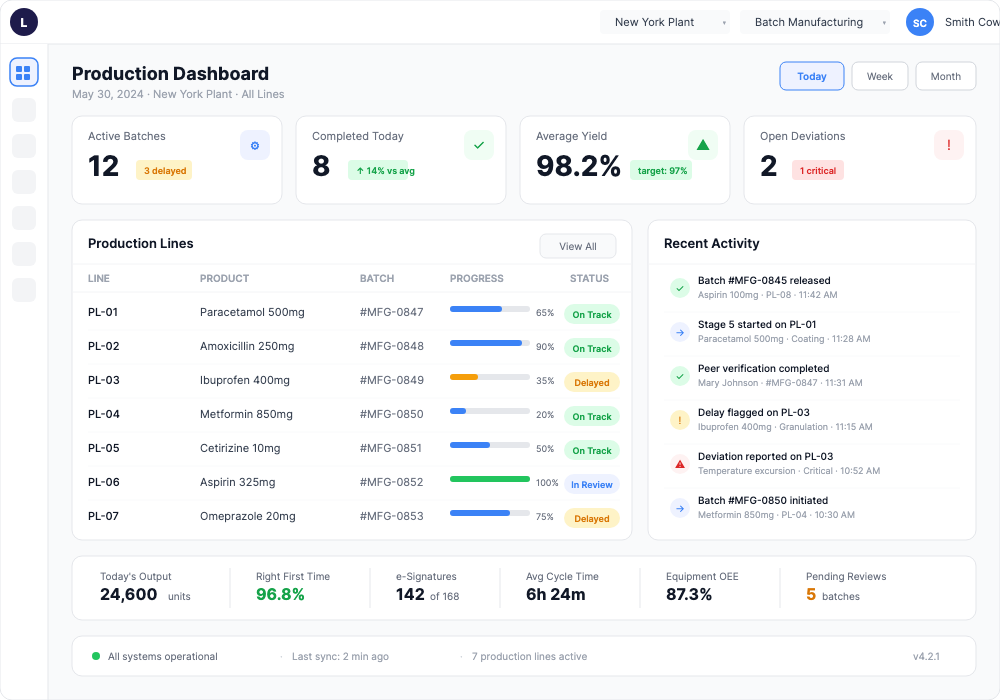
The plant-manager dashboard.
Active batches, completion, yield, open deviations, production lines with progress and status, recent activity, right-first-time, e-signature counts, equipment OEE.
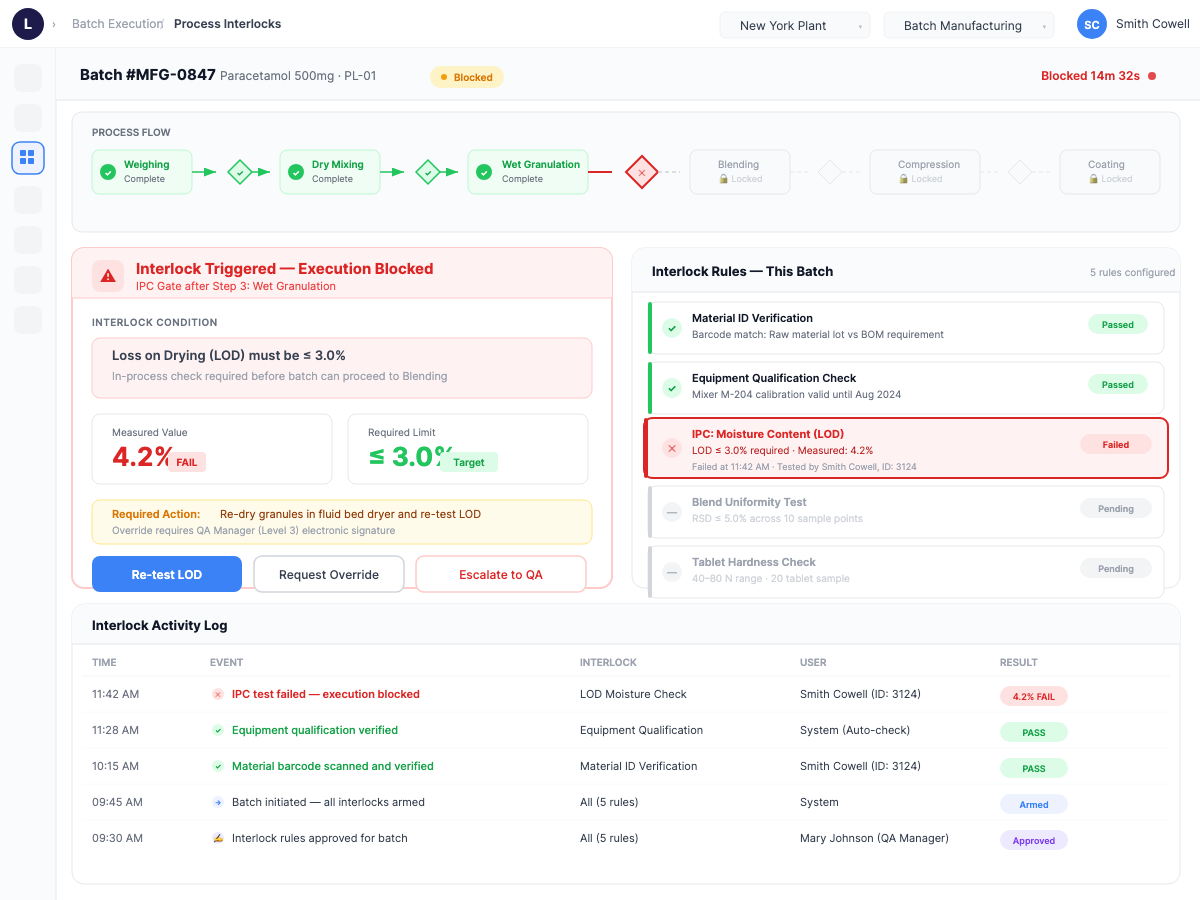
The process interlock — hard-blocking an out-of-spec batch.
When an in-process check fails (LOD moisture above the 3.0% gate), execution hard-blocks — the batch cannot proceed to Blending. Override requires a Level-3 QA Manager e-signature, and every interlock event is logged. The system says no before the operator can.
Ten decisions the platform compounded on.
Not the only ten — the ten the system bent around. Each started as a customer escalation, an audit finding, or a flat refusal from a plant manager, and each became a primitive every later module reused.
Decision
What it reveals about how Janam thinks
Master / instance separation.
Rebuilt ISA-88 from first principles before knowing the standard existed. The bug taught the architecture.
Industrial-tablet-first interaction model.
Hardware constraints come first, aesthetics second. When operators route around the product back to paper, the form factor lost.
Mandatory-block hard refusal.
Forcing the operator to face the gap at task time is cheaper than forcing QA to face it at batch-release time.
Stage hierarchy as the unit of execution.
The hierarchy is the audit trail. Reviewers think in stages; the product had to mirror that or lose them at review.
Prototyping module — no-code SOP builder.
The differentiator that closed the first four customers. Without it Leucine ships bespoke checklists; with it, the platform is buyable.
Pre-assembled logbook templates.
Cut onboarding from weeks to days — removed the single biggest reason new customers churned in month one.
Camera OCR on weighing balances.
Any analog readout can become structured input without retrofitting hardware. Kill manual transcription, not the device.
Process interlocks — declarative refusal.
The system says no before the operator can. Cleaner than training, cheaper than auditing, fires every time at 3am.
Inbox — unified QA review queue.
QA is the bottleneck of every batch release. Concentrating their work in one queue compressed review cycles ~40% at Cipla.
Designing the surfaces of an ontology-first model.
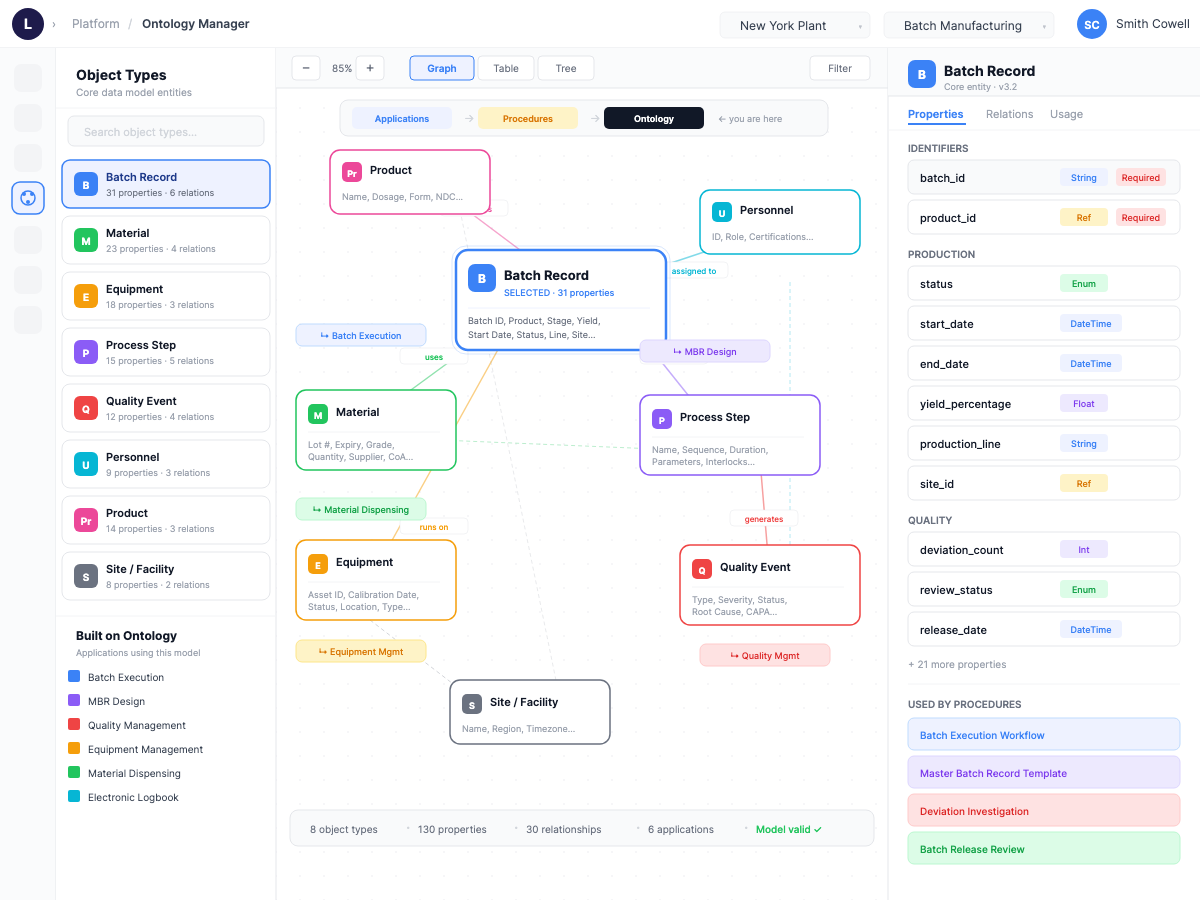
The CPO set the ontology-first direction; I designed how every module references shared entities instead of forking its own data. That design work is what later made the model legible to the Cortex AI agents.
The shopfloor visit that reset four years.
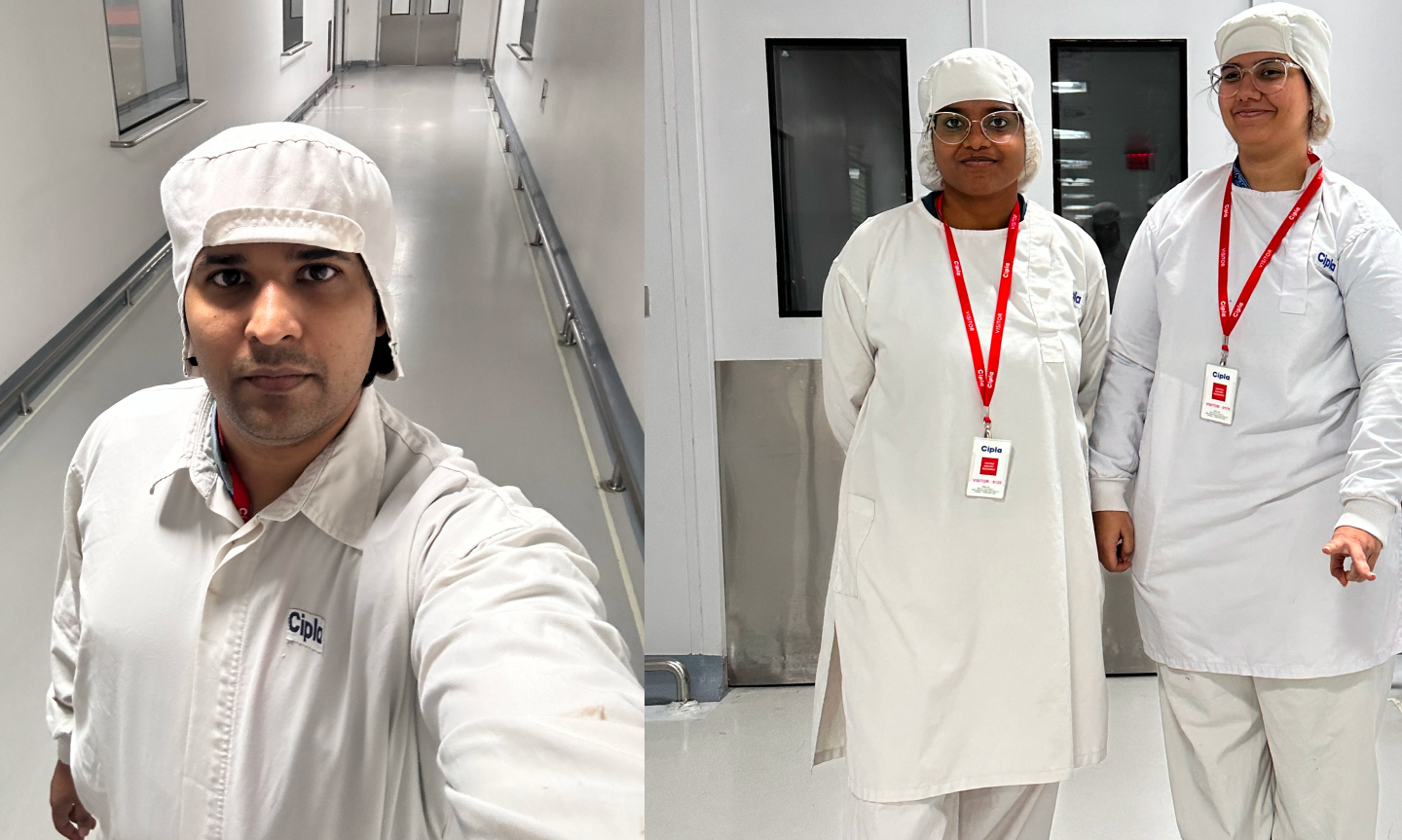
In February 2022 at Cipla Indore, an operator told me they still wrote everything on paper — because if the tablet crashed mid-batch the digital record was gone, and at audit time it's only the paper a regulator accepts as proof. That one sentence reset every assumption from week one. The next four years were spent making the digital record more trustworthy than paper, not just compliant: crash recovery, dual persistence, supervisor exception flow, signature attestation, structured deviation logging.
The killed feature. I pitched a full prototype review flow with branching approval and inline annotation; the founder cut it at deal-close to compress scope. The stripped-down 3-pane builder shipped instead — drag a primitive, configure, save — and it closed Zydus plus three more in Year 1. The full review flow shipped in Year 3, when the platform could carry the weight. The cut was right; the argument made the design defensible. Scope discipline at deal-close beats feature richness at demo.
How the team scaled. Two years solo (2020–2022) was a deliberate cadence — the architecture needed time to harden before more designers could safely extend it; hiring earlier would have duplicated the master/instance debt across more pairs of hands. By 2023 the system was legible enough that a five-person team could take modules end-to-end. In June 2025 the role bifurcated: the team owns the screens; I own the world model the agents reason against and the surface where humans approve their work.
The AI inflection — and whose bet it was.
The ontology-first platform direction was the CPO's strategic call, made in 2022 to stop modules duplicating their own data models. My job was to design its interface layer — how every module references shared universal entities (Equipment, Material, Procedure, Batch, Personnel, Site) instead of forking per module, and the screens humans move through. When Cortex's agents later needed a structured world to reason against, that same ontology — and the legible surfaces I designed on top of it — was exactly what they could operate on. The lesson isn't that I predicted AI; it's that designing cleanly against a sound architecture meant the design held when the inflection arrived. Cortex itself was built by a separate engineering team; what I designed is the human-facing surface where operators and QA approve what the agents propose.

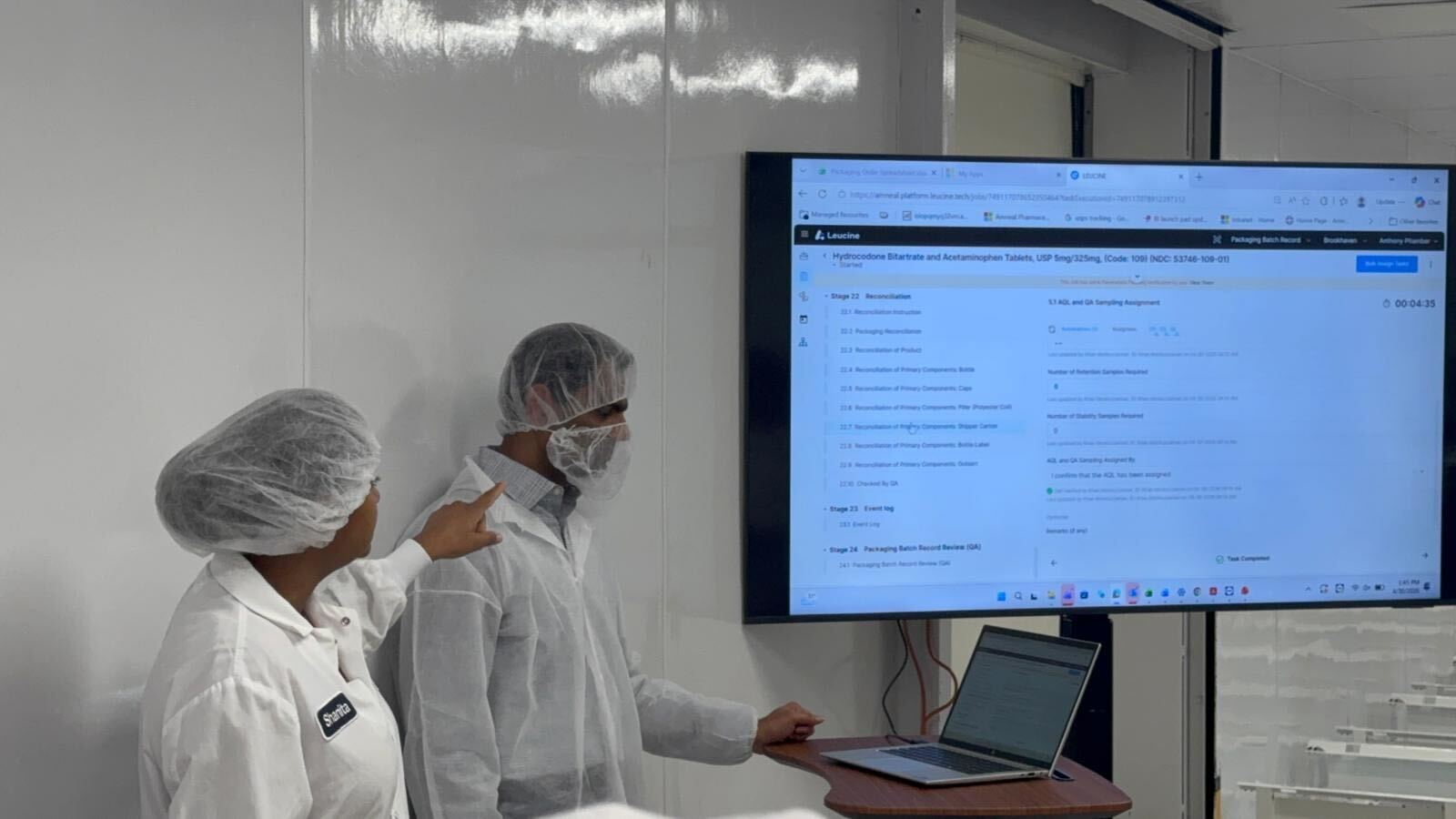
Validated by senior operators across four continents.
The platform runs across 51 pharma enterprises and 370+ GMP sites — Cipla, Dr. Reddy's, Amneal, Biocon, Valent BioSciences, Revlon, Viatris, Zydus, Lupin (representative, not exhaustive).
Cipla
Dr. Reddy's
Amneal
Biocon
Valent BioSciences
Revlon
Viatris
Zydus
Lupin
51 PHARMA ENTERPRISES · 370+ GMP SITES · 4 CONTINENTS · NAMES REPRESENTATIVE
Commercial frame.Most pharma MES rollouts take 18–36 months and 30–60% fail to reach planned scope — Körber PAS-X, Rockwell PharmaSuite, SAP ME/MII all carry heavy ISA-88-modelling and PLC-integration debt. Leucine landed on the operator surface first, then extended down to the substrate, with a 2–6 month implementation. A Plant Manager at a Valent BioSciences cleanroom in Iowa noted their operators actually want the digital tablet at their station now — which wasn't true with the last system.

The receipt: a Huvepharma audit collapsed 15 manually-transcribed paper fields into 1 controlled subtotal — a 92% reduction in uncontrolled data entry, 100% global harmonization across plants.
Scope boundary — stated plainly.What I designed is the interface and interaction layer across the platform: how the product reasons visually, the master/instance and stage primitives, the operator and QA surfaces, the builders, dashboards, and interlocks. I did not set the ontology-first platform strategy — that was the CPO's call — and I did not build Cortex, which a separate engineering team built. What I own on the AI side is the world model the agents reason against and the surface where humans approve their work. The regulatory frameworks (FDA, EMA, ICH, WHO) belong to the regulators. Being precise about what I designed is what makes the rest credible.
The primitives I drew in 2020 today run 51 pharma enterprises and 370+ plants — because the same designer kept extending them, module by module, version by version, and because the architecture they sat on was sound enough to design against for six years.
Three lessons I'd apply on day one of the next regulated-domain platform: read the standards earlier (ISA-88, ISA-95, GAMP 5, ALCOA+ — I rebuilt half of them by accident); visit the shopfloor in week two, not month eighteen (the Cipla Indore visit reset four years); and treat a sound data model as architecture to design against, not a refactor to retrofit — when the strategy is right, the leverage is in designing cleanly on top of it from the start.